6am in the forest. Frost in the air. The black branches of the pines perfectly still, and between the branches the stars. The sickle of Leo. The cup of Corona Borealis. Jupiter in the west, very brilliant, coming and going between the dark trunks, reflecting sometimes as an eye-catching splash of yellow in the puddles. The crescent moon low in the south, hanging jauntily on one corner of Virgo (perhaps they had been partying), above a sea of mist.
The Animals in That Country by Laura Jean McKay tells the story of Jean, who works in a wildlife park and has a special relationship with the dingoes, which is developed much further when a plague leaves people able to interpret the body language and noises of animals as speech.
Jean ends up going on a road trip with Sue the dingo and sees first-hand the implications and consequences of this increased connection between humans and animals. And it's not pretty.
This book is not an easy read - but it's definitely a worthwhile one. I particularly like the fact that what the animals say is weird, alien and largely very creepy. The books is fairly unpleasant in places, but it's both impactful and compelling - I read it in two days and stayed up way too late reading on both of them!
In terms of its arc, it really reminded me of Flowers For Algernon. It didn't hit as hard, but I thought it was really good overall.
Here's a tip for getting a new scale after not having one for a really long time... Yesterday, when the scale arrived, it was mid day and I was fully clothed - I tried it out. I did take off my shoes. Today I weighed myself right after I got up and peed. Nearly no clothes. I lost a kilometer!! And my scale draws a little graph line so mine went way down. VERY satisfying. Fictional but satisfying. (And, yeah, my doctor's office tracks weight in kilograms so I decided to follow suit.)
I had a text from NovoCare this morning wanting me opt in to texts. So I know they have my number in their system for sure and it's just a wait.
When the new closet gets installed, the cat beds will have to move. They are heated but one of them doesn't even heat any more. So I ordered them a big, heated dog bed with bolsters. Since under the bed is now empty and I do NOT want to use it for any storage, I'm planning on putting the dog bed there. They like it under there anyway.
This afternoon is my first Food and Beverage Committee Meeting. They meet in private on the 2nd Wednesday and then hold a public meeting on the 3rd. Should be interesting. Before that - this morning - is exercise class at 10. In between, I might make a quick trip to the grocery store. I want some yogurt and cheese and maybe other stuff.
That's rather a busy day for me. Better get going with it.
During the month of December I tried something out: I wanted to get back into the habit of daily writing at 750Words, but instead of focusing on trying to be constantly creative or working on another project, I focused only on just getting words out. Any words, whether it was a personal ramble or working out a stubborn plot issue. Didn't matter what I wrote, as long as I wrote it. That was the whole point: the focus was on just doing it, no matter what 'it' was. And at by the end of the month, I was back in the habit. I still have Don't Wanna days, but it's a lot easier to get through them now. I just power through and get it done.
Basically saying this now, because this is something I realize I need to do with my other creative outlets as well. I've gotten a little better these last couple of days, getting back to journaling and artwork, though I still need to carve out some time for my guitars! Again, I'm not necessarily focusing on creating something big or important, I just want to focus on doing it, making it a normal everyday habit again.
Meanwhile, I just need to get through the next four work days at the Day Job, then I have a full week off! A vacation already, you ask? Well, this is what happens when my birthday is in January and I finally have a day job where I don't have to fight to take a few days off. We're not planning to go anywhere far, just a few day trips here and there and enjoying the time off. I will of course try to continue my daily creative work when and where I can, but I'm definitely looking forward to this little break!
LIST THREE (or more) THINGS YOU LIKE ABOUT YOURSELF. They don’t have to be your favorite things, just things that you think are good. Feel free to expand as much or as little as you want.
Post your answer to today’s challenge in your own space and leave a comment in this post saying you did it.
1. I collect a lot of resources, and can figure out how to solve a lot of problems using them. Psych resources, therapy resources, internet and technology tutorials, guides for lots of different real world topics (I miss Expert Village so much y’all).
2. Despite being raised in judgment of myself and others, I have learned a lot of lessons about flexible boundaries, realistic and gentle expectations, and the overall re-write-ability of the social contract between individuals. It means I am a lot less likely to make judgments about things that do not directly harm others. (That being said, FUCK ICE.)
3. I am the creative type and tend to make things when I am not too busy to de-stress. It’s what I do to unwind. And since I have fibromyalgia, I need that time, since I am chronically sleepy and in a bit of pain at all times.
4. I handle pain pretty well. I can’t always use it as a whetstone to sharpen my empathy for others, but even when I can’t, I no longer bleed on people who did not cut me.
I think that’s the good stuff I like about myself today.
Image: albino loon (one of which has been spotted near Minnesota) melting ICE with LASER EYES by Cat Saint-Croix.
I have to say that I also really love the outpouring of art that has been happening.
Speaking of art, last night I happened to see that a group of my Hamline-Midway neighbors were gathering at a random street corner to sing. The idea was just to gather in a low-risk way so that some very little children could join. Also, in hopes that if there were neighbors nearby in hiding from the gestapo, they could hear our voices. The temps are dropping here, so there weren't very many of us. Probably a dozen? But we stood together in a circle and raised our voices and sang old protest songs, some hymns, and even one pop song ("Lean on Me.")
Did it stop ICE? No. Was it extremely cathartic? Fully. Did I heal my soul a little? Yes, it helped.
In my effort to do SOMETHING every day, I'm hoping to join one of the pedestrian bridge brigades today. It's at an awkward time for me (right when I need to get Shawn from work), but, if nothing else, I might spend some time making a poster or two.
It's funny because we are absolutely a metro area under seige, but it is also fully possible to go through your day and not see anything? My grocery stores are open--even Shanghai market. Shawn is going to work. Mason is applying to law schools, going over to his uncle's to do handiperson work... life is kind of going on, while also very much NOT for so many of us.
In a town preoccupied with literally tearing down its past like Houston, a tree that's been around for four centuries should be more significant. Instead the live oak blocks away from Allen's landing in downtown has the more sinister but false stigma attached to it as a hanging tree.
It even had a plaque in place calling it the old hanging oak until its removal in the 1990s. While there are some true hanging trees in and around Houston, this old oak was proven to not be one of them and should be more known as one of if not the oldest living thing in the city.
The elusiveness of lasting peace isn’t a new problem. The ancient Greeks struggled to maintain it, even if they considered peace an ideal state. As Homer did in his Odyssey, many early poets paired stability with prosperity.
Athens was one of Greece’s most powerful city-states in the fifth century BCE. It dominated the seas with its naval power. While arts, philosophy, and democracy flourished, the golden century was also plagued by continuous warfare. The Peloponnesian War, the draining conflict with the rival polis Sparta, lasted from 431 until 404 BCE, with a shaky 15 years of detente in the middle. Whether against their expansionist Eastern neighbor, Persia, rival Greek city-states, or rebellious allies within its empire, Athens was involved in conflicts for a large part of the century.
The Peloponnesian War was a clash between two superpowers with fundamental ideological differences. Sparta was a military-led land power; Athens a democracy with a strong naval tradition. Their lack of trust was not unfounded. Athenians saw war as a way to glorify their city, weaken rivals, and stop enemy encroachment upon their lands. They used attacks and looting to gain resources, as the city had no alternate sustainable economic policy. They would welcome peace only after totally wiping out the enemy.
The Peloponnesian War ended in 404 BCE with Athens’s devastating loss. Its once heralded naval fleet was largely destroyed. Plague and defeat on the battlefield had killed more than a quarter of its people. Conflicts and epidemics had left the Athenian economy in shambles. Restoring prosperity required lasting peace, but asking the proud Athenians to lay down swords after humiliation was a political gamble. They needed a more straightforward approach to ending aggression.
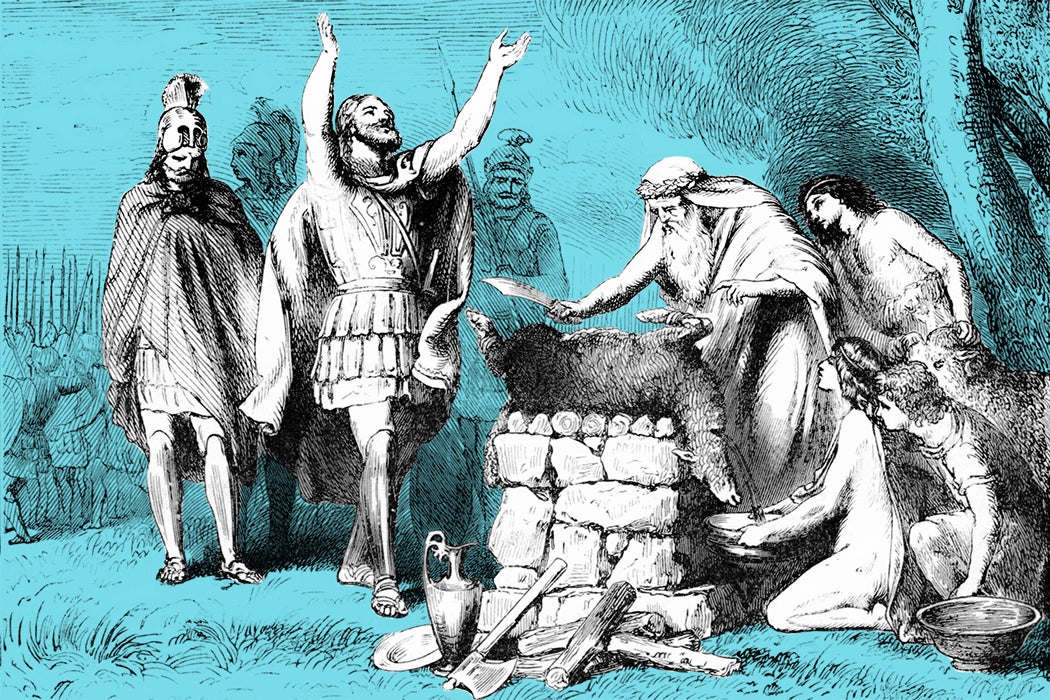
After decades of war, the Athenians decided peace would no longer be an abstraction. Instead, it would be personified as a deity, the goddess Eirene, and worshipped as such. To be clear, religion in ancient Greece was not “faith” in the way we understand it today. It did not necessarily guide individual’s private thoughts or provide a moral compass. Instead, it was deeply embedded in public life. Practicing religion was a social and civic duty, aimed at maintaining harmony between mortals and the divine. Religious acts such as prayers, libations, and dedication of votive offerings were typically performed at public shrines and altars. These were visible, communal gestures, often tied to festivals, civic events, or transitions in life, such as marriage, war, or death.
Weekly Newsletter
[contact-form-7]
Each city-state (polis) had its own religious calendar and patron deity—Athena in Athens, Apollo in Delphi, Hera in Argos. While the Greeks shared a pantheon of Olympian gods, there was no single, unified “Greek religion.” Worship was organized into local cults—a term that, in the context of ancient religion, simply refers to the structured worship of a particular deity or hero at a particular place. Indeed, it bears noting that the word cult comes from the Latin cultus, meaning “care” or “tending,” and carries none of the negative associations we project onto the word today.
Moreover, ancient Greeks believed that the gods were in some ways related to them—indeed, mythologies often linked the divine and the human, indicating a comingling of the two that is absent from the Abrahamic traditions that have come to predominate in the US and Europe.
There had been previously no religious practice, mythology, or cult activity surrounding Eirene. She is briefly mentioned as a gentle figure in myths that date from the seventh century BCE, where the idea and image of her was communicated to the Athenian public through works of theater. Eirene appears in Euripides’s tragedy Cresphontes (produced circa 424 BCE), when the chorus sings a hymn to peace, beckoning her into their city. A few years later, Aristophanes rejiggered Euripides’s creation as a basis for his satirical Peace (421 BCE). Theater offers a prime example of how divine personifications were introduced in visual rather than written form, and in the case of Eirene, these plays laid cultural groundwork for later cult practices.
The cult around the personification of Eirene was established in roughly 375 BCE, a few decades after Aristophanes included her in his work. The citizens of Athens erected a large bronze statue of Eirene in the main public square, agora, around that same time. Sculpted by Kephisodotos the Elder, it was designed as a daily reminder of the centrality of peace in Athens. She is depicted holding a scepter—a symbol of authority—in her right hand. In her left arm, she holds the child Ploutos, who serves as an allegory of wealth. Posed together, the two figures representing peace and wealth communicate the notion that peace is not simply an absence of war, but a prerequisite for prosperity.
Religious devotion to a political ideal might be a foreign concept to contemporary readers, whose understanding of worship includes rituals, practices, and faith. The ancient Greeks, however, held no clear division between religion and politics; the two were intertwined. Honoring Eirene—or any Greek god—was a public affirmation of civic values and diplomatic goals.
Eirene was celebrated with an annual festival that included animal sacrifice and religious processions, as was the custom. Army generals oversaw the festivities, during which some 85 oxen were sacrificed. These activities likely happened in agora, but the statue of Eirene was symbolic, not part of the cult; there was no altar or temple around it, suggesting it served as a public monument rather than an object of worship.
The ritual of animal sacrifice in ancient Greece brought humans closer to the gods even as it defined their differences.
These public religious activities for Eirene were important; for Greeks, religion was not a matter of private belief but rather of outward action. The worship of a deity happened in a public space around a cult image, not privately inside a temple. The most important element of the cult activity was the altar, which stood outside, in the open air. The location of Eirene’s altar is not known.
In Greek thought, there was no conflict between religion and warfare. Although Athenians worshipped peace, they simultaneously continued their devotional activities aimed at Ares and Athena, the half-siblings who are, respectively, the gods of war and strategic warfare. Ancient Greek religion, as indicated above, had no clear moral code. Gods themselves were not necessarily good, nor did they always act in a manner we would consider admirable. They often seemed to delight in violence and battle. According to the classics scholar William Chase Greene, Zeus himself seemed to take “pleasure in the carnage.”
Ancient Greeks took a very flexible approach to religion. Adding new personifications with a particular function was common. Along with the established pantheon of twelve Olympian gods, the Hellenistic world was likewise populated with minor gods, mythical characters, and local heroes. Spirits and gods embodied abstract concepts or natural elements. Health matters, for example, were left to the capable hands of the god Asclepius and his daughter Hygeia. Archaeologist and classics scholar T. B. L. Webster counts almost 300 different personifications for various concepts, from democracy to good fortune.
Ancient Greeks were also practical about religion. There was no holy text, no central authority organizing devotion, and knowledge about gods came from mythology, written down as epic poetry, or depicted in visual arts. Gods were related in a quid pro quo manner. People offered them prayers, gifts, votives, and the bones and smoke from animal sacrifices, while Athenians feasted on the meat and sold the hides. In return, Athenians expected happiness, health, and good fortune.
These were shared religious principles and while Greeks honored one another’s festivals, different city-states placed their own emphases on specific local cults, like that of Eirene. Athenians celebrated peace through public worship and ritual, yet this did not transform their deep-rooted civic identity. The goddess of peace might have stood in the agora, but she stood amongst citizens still shaped by deep pride and patriotism.
The identity of Athenian male citizens was tethered to being a soldier. Military training typically started at the age of sixteen or seventeen and lasted about two years. The training included military preparation, hunting, and sports, but also guarding government buildings and, maybe most importantly, taking an oath to serve their city, as Ronald T. Ridley explains in “The Hoplite as Citizen.” Because wars broke out as often as every three to four years, many men had first-hand experience in battle.
The city was decorated with public art, reminding people of shared values. Statues and reliefs celebrated heroic soldiers and their patriotic sacrifices. Perhaps the most poignant example stood atop the Acropolis hill, Athens’s religious, political, and cultural center.
Dedicated to Athena, the Parthenon temple on the Acropolis was decorated with a colorful frieze, depicting the divine connection between the gods of Olympus and the citizens of Athens.
An idea of desirable, all-abiding, permanent peace was a new concept in the fourth century BCE Greek political thinking. Peace agreements had been concluded before, but they were not meant to be permanent and none of them lasted long. Eirene was the embodiment of a newfound hope for a more lasting peace that could unify the country. However, despite the hopes Athenians placed in Eirene to deliver on this goal, appeals to a divinity could not prevent war. Worshipping a deity did not create practical mechanisms for diplomacy or conflict resolution.
Despite Eirene, the rivalry between the city-states endured, and their economies remained dependent on conquest and expansion. By introducing the cult of Eirene, Athenians sought to refashion themselves in the eyes of other city-states as champions of unity and peace. However, their celebration for peace became more of a display of Athenian strength, not goodwill, as Emma Stafford observes in Worshipping Virtues. Historian Walter Burkert goes a step further, describing the cult of Eirene as more propaganda than religion in his work Ancient Mystery Cults.
Eventually, the Greeks realized that peace was fragile, something that could be celebrated but not enforced—certainly not via animal sacrifice to a god. Though the cult of Eirene remained part of Athens’s major festivals through the late 330s BCE, her importance diminished thereafter.
And what happened to the great sculpture of Eirene on the agora? Like most bronze works from this era, it did not survive, though its likeness was depicted on contemporaneous vases and coins. Considering the persistence of war over millennia, a poet or a cynic might even consider the loss of a sculpture of the goddess of peace nothing if not a fitting, tragic, timeless metaphor.
Sounds like we are starting to get under somebody's skin.....
Donald Trump Yells 'F--k You' and Flips Off Man After Being Called a 'Pedophile Protector.' White House Defends His 'Appropriate' Response A White House spokesperson said Trump gave 'an appropriate and unambiguous response'
How did the decluttering of the hobby spaces go? Did you spend time looking for things that could go, move a thing or two, or have a wildly successful week? Or did you work on a different space instead?
For the third week, we are moving on to a work space -- just the one. Unless you have all the energy and all the time, in which case don't let me hold you back. But this was meant to be a gentle challenge to get started on the year. What decluttering a work space might look like
moving the cooking equipment you never use out of the kitchen
sorting through stuff in a work from home space so you have more space for you
looking in the laundry for things that have drifted into corners and become one with the wall.
going through the cleaning rag stash and getting it down to Just! One! Bucket! worth (for whatever size of bucket you keep your rags in)
throwing out old cleaning equipment--particularly if you have replaced it with one that you use!
Alternatively: keep going with the rest and / or hobby spaces. Get things out of the house!
Comment with Just One Thing you've accomplished in the last 24 hours or so. It doesn't have to be a hard thing, or even a thing that you think is particularly awesome. Just a thing that you did.
Feel free to share more than one thing if you're feeling particularly accomplished! Extra credit: find someone in the comments and give them props for what they achieved!
Nothing is too big, too small, too strange or too cryptic. And in case you'd rather do this in private, anonymous comments are screened. I will only unscreen if you ask me to.
Elizabeth Enright’s Then There Were Five. That’s right, the Melendys are back! This time, they befriend a local boy with no friends or relations except his horrible uncle, and the Melendy children take him home and ask “Can we keep him???” They gather scrap metal for the war effort, plan a festival (children in books always throw the most satisfying festivals), and put up a truly astonishing amount of tomatoes.
What I’m Reading Now
Onward and upward in Solzhenitsyn’s In the First Circle! The blurb on the front of this novel praises it as “suspenseful,” which is fascinating because that’s probably the last adjective I’d use to describe it. Absorbing, yes. Full of meticulous portraits of a dizzying array of people, yes. We meet a deeply religious prisoner, a soft-hearted prison guard, Stalin, a prisoner who still believes fanatically in Communism, a prisoner’s wife whose devotion to her husband is cracking under the strain of separation, her friend in their grad student dorm who is trying to wriggle free of being recruited as an informer…
But suspenseful? I wouldn’t call it suspenseful. We’re halfway through the book and we’ve just now meandered back to Volodin, the guy who telephoned the American embassy on Christmas Eve to warn them that the Soviets are planning to steal their atomic bomb secrets. We are not urgently searching for Volodin (well, maybe the fanatically Communist prisoner Rubin is urgently searching for Volodin), we are gently bobbing around in a pool and occasionally bobbing a bit extra hard when we come across one of the ripples caused when Volodin tossed his pebble.
Title: Return Of The Living Socks Fandom: Torchwood Author: badly_knitted Characters: Ianto, Sock. Rating: PG Word Count: 842 Summary: Out on a Rift retrieval in Bute Park, Ianto encounters an alien creature he had hoped never to see again. Spoilers: Nada. Warnings: None needed. Written For: Challenge 503: Sock. Disclaimer: I don’t own Torchwood or any of the characters.
Title: so black & blue for you Fandom: The Orville Ship: Kelly Grayson/Alara Kitan Medium: Fic Rating: T Length: 507 W Notes: Also for 100femslash prompt "beat" & femslashfete prompt yield Summary:
Kelly teaches Alara about the human sport of wrestling.
A muddy, unseasonably warm day can feel strangely heavy. The wind pushes across the yard like it’s in a hurry to leave, and the soft ground seems tired of holding on to winter. With the temperature climbing to 7 °C, the last scraps of snow are slipping away, shrinking into nothing by evening. There’s something a little lonely about watching them go, as if the season is fading before it ever really had a chance to settle in.
Just finished: Invisible Line by Su J. Sokol. This was quite good. Xe did a good job in not just complicating utopia—I have a minor dislike of "flee to Canada" as a plot point in dystopian fiction, and the portrayal of Montreal as a bureaucracy subject to limits on its ability to do the right thing is very nuanced and well done—but also making the characters messy and traumatized. The big crisis in the last act could have been averted if the parents talked to their damned kids, but of course they are too paranoid and distrustful from years of living under fascism, so they don't. Looking forward to reading the sequel.
Currently reading: Mavericks: Life stories and lessons of history's most extraordinary misfits by Jenny Draper. This is really fun—TikTok-sized portraits of history's interesting (not always good) characters. I knew about a lot of them, like Ellen and William Craft and Noor Inayat Khan, but a lot of the others, like Eleanor Rykener and The Chevalier d'Eon, are new to me. It's very fun and conversational.
![[personal profile]](https://www.dreamwidth.org/img/silk/identity/user.png) puddleshark
puddleshark


![[community profile]](https://www.dreamwidth.org/img/silk/identity/community.png)


![[syndicated profile]](https://www.dreamwidth.org/img/silk/identity/feed.png)